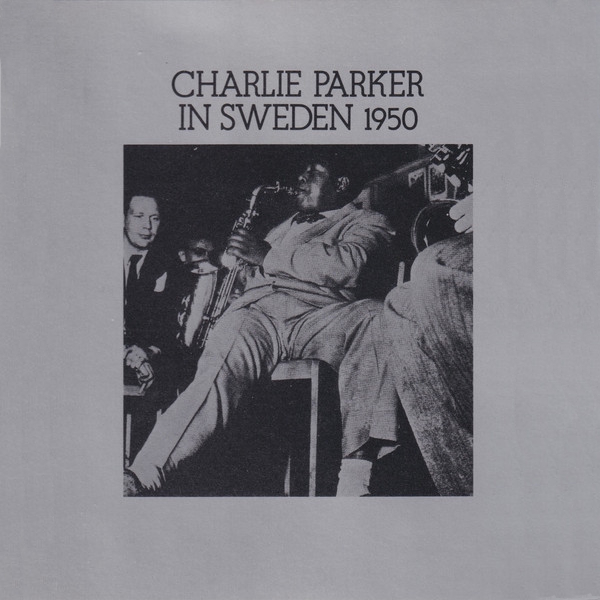
You may be interested to read the liner notes by Lars Werner (1934-1992) from an album recorded in 1950, released on vinyl in 1959 and re-released on CD in 1986. Mr. Werner's original notes were updated by jazz journalist Chris Albertson (1931-2019) in 1979.
Before jets and a proliferation of festivals made European appearances by American jazz musicians quite commonplace, it was not unusual for a trans-Atlantic tour to be preceded by six months of publicity. But such was not the case in November 1950, when Charlie Parker's arrival in Sweden literally took some fans by surprise. The trip was made on such short notice that booking negotiations virtually continued until his day of departure from the States. Rumors of impending visits from Parker had circulated from time to time, but so exciting was the prospect that one dared not believe them. Given the scarcity of live jazz in Europe at that time, and the fact that Charlie Parker, the Messiah of modern jazz, was already achieving legendary status, it was preordained that this visit would be a particularly memorable one. Accordingly, the November 20 Stockholm concerts and the all-night jam session (sponsored by the Stockholm Jazz Club) that followed are among my most profound and memorable emotional experiences; I am sure that Charlie Parker deeply touched everyone who heard him play on this tour, but, oddly enough, he had very little influence on his Swedish colleagues. Sure, those who accompanied Parker seemed to play with more fire and swing than usual, but that was the extent of the influence, and if it went deeper at the time, it did not surface until later.
We know now that 1950 was a good vintage for Parker's music, and he probably knew it, but in Sweden 'cool' jazz was the thing, and local musicians were far more interested in Woody Herman's Early Autumn, Stan Getz's Yesterdays, Miles Davis’ Godchild, and Lennie Tristano's Wow. By the time Parker died — prematurely, some five years later — his music and importance to jazz had become fully appreciated, even in Sweden.
The material in this album was recorded privately and under primitive conditions by a fan attending Parker's November 24, 1950 concert at the Halsingborg Folkpark and an ensuing jam session. By today’s standards, the technical quality leaves much to be desired, but such was the magnitude of Parker’s art and brevity of his career that we have learned to cherish every inch of tape containing his work. If you are a Parker collector, you will know that, substandard though it is, the sound on this album is infinitely superior to many of the private Parker recordings that have surfaced in the last two decades, but even more important is the fact that he is in splendid form. I have often wondered why it is that every new Parker solo seems to be quite different from the preceding ones even when he uses the same melodic lines; part of the answer may lie in the fact that he had such strong emotional reactions, such a great command of musical phraseology that the same line could take on an entirely different meaning from one moment to the next. But the why and how will concern only a few; what is really important is the assertive, free music in this album — long, beautiful, easy lines that lead to some of those humorous, marvelously integrated interpolations that were typical of his best work. I hope it proves to be as exciting to you now as it was to the approximately one thousand people who crowded into the dance hall of Folkets Park in Halsingborg and the seventy-five who were lucky enough to attend the session that followed, thirty years ago.
True to form, Parker opens the concert with his own Anthropology. playing magnificently in a relaxed up tempo; listen to the way he roars into Buttons and Bows, the Dinah Shore hit of that period, obviously inspiring Rolf Ericson, whose forceful trumpet style was patterned after Red Rodney's. Ericson's solo was originally followed by one from pianist Gosta Theselius, but here — as on the rest of the album — we have found it necessary to delete the piano solo due to inordinately improper balance. Scrapple From the Apple serves well to illustrate Parker's command of sequence playing; notice the way he starts his solo, the beginning of his third chorus, and the first four bars of the last eight. Parker had a wonderful affinity for ballads, and Embraceable You, which he takes in a slow to medium tempo, brings to mind Quasimodo, which he based on that tune: notice his beautiful second chorus and that by now famous Country Gardens coda. Parker's first chorus and his transition to the second are highlights of the faster-paced Cool Blues, which also contains a swinging ensemble. Star Eyes, which ends side one, and All the Things You Are, which begins side two, were originally played in tandem without interruption; both are, of course, well-known Parker vehicles by now, and he plays them here with characteristically interesting asides. Ericson solos to good advantage on the latter tune and on Strike Up the Band, which ended the concert, but does not end this album. Following the concert, some seventy-five jazz fans and musicians retired to the restaurant for refreshments and, of course, more music. There, in a relaxed atmosphere amid food and drink, some beautiful Parker solos emerged and, fortunately, were recorded. Body and Soul — which became a classic at the hands of Coleman Hawkins — is played in the popular double tempo of the day, we enter it just before the bridge, in time to catch two and a half choruses of graceful, singing lines by Parker. Here, again, some heavy editing was called for and, following Parker's solo, it was necessary to remove lengthy statements by Norwegian trumpeter Rowland Greenberg and Gésta Theselius (playing tenor this time); both men are, however, heard during the out chorus wherein Parker injects a lovely fragment of Debussy's Claire de Lune, and Greenberg rounds things out with the obligatory strain from Prisoner of Love. With Theselius on tenor, the pianist for this informal session was Lennart Nilsson, but he too was a victim of poor balance whose work had to be edited out; if there was a bassist present {some discographies list Thore Jederby as a possible participant), the non-professional tape recorder refused to acknowledge it.
Parker kicks off Fine and Dandy with five driving choruses, the first two of which receive some good brush-work backing that has been attributed to drummer Jack Noren, but some corny 'bombs' elsewhere on these recordings belie the notion. Here, again, editing was called for and I had to discard a decent but overly long solo by Rolf Ericson, and one by Lennart Nilsson (you will notice the jump to Parker’s second entrance, which consists of a quote from When the Red Red Robin..., etc. and leads to his trading fours with Ericson before easing into Miles’ Little Willie Leaps for the last sixteen bars). The final number, How High the Moon, starts charmingly with an a capella statement from Parker, who presumably is also responsible for the foot-tapping that sets off the rhythm section. Here, too, editing was done, but mainly to make room for the out chorus and its Ornithology theme.
Lars Werner,
Swedish jazz critic, Orkesterjournaien.
Original 1959 notes edited and updated by Chris Albertson — 1979.