Jazzers Blog

Perry Bradford Bands of the 1920s

GulfCoastSeven cover1x400

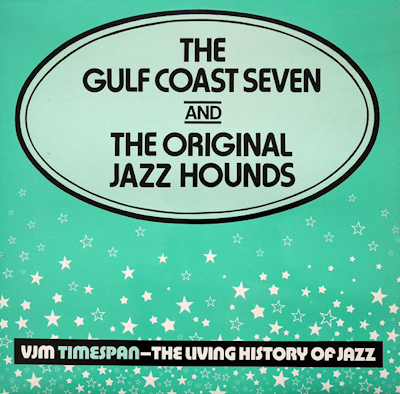
Perry Bradford (1893-1970) was an important catalyst in the early days of jazz and blues recording. Primarily due to the market crash and Great Depression years in the U.S., Bradford slipped away into obscurity and never recovered his prior prominence. These notes from "The Gulf Coast Seven and The Original Jazz Hounds" on VJM Timespan by British jazz discographer Brian Rust (1922-2011) help us to understand some of the complex history and significance of these vintage recordings.

This album presents eight magnificent sides recorded between 1923 and 1928 under the direction of Perry Bradford, a prolific composer, vocalist and impressario. Born in Montgomery, Alabama, on February 14, 1895, he was working in various minstrel shows in the south while still a child; he first visited New York in 1910, and by the end of the decade he had established himself there as a composer-pianist with drive and ability. To him must go the credit for “placing” Mamie Smith as the first black woman to record a blues (his own Crazy Blues, for OKeh, made in the summer of 1920, sold over a million copies, and can be regarded as the starting point for the flood of blues records that has never ceased since, in some form).

Although by no means a modest man, Perry Bradford plays on relatively few of his records, although his voice can be heard on many. The musicians he worked with on his sessions include some of the finest talent in Harlem at that time, and the tracks on this record show them at their best, The Aiken brothers were among the first black brass players to record extensively; both use broad, rich tones and show a keen sense of balance in the close-knit ensemble passages, and on the third Gulf Coast Seven date, we have a chance to hear, electrically recorded, the legendary June Clark, of whom it has been said he was a serious rival to Louis Armstrong himself. If Thornton G. Brown was not quite in that class, he was certainly more than just another brass player, and it is strange we know so little of him. Louis Metcalf, of course, ranks with the finest, most expressive of all jazz cornet and trumpet players. His playing comes across as a forthright challenge to all other brassmen, but never coarse, never garish; colourful but not cheap, and always in perfect control, and a master of the use of mutes that Joe ‘‘King’’ Oliver, Bubber Miley and Cootie Williams alone could match.

The other brasses we hear on this record include the shadowy figure of trombonist Jake Frazier, a competent soloist but a superb ensemble man, and the brilliant technician who never abused his gift, Jimmy Harrison. The third Gulf Coast Seven date gives us our first chance to hear how the great Harrison, lost to us in 1931 at the age of thirty, sounded before he joined Fletcher Henderson. (Buster Bailey then still in his first year with Henderson, is also present; always dependable, he and the great tenor saxophonist Prince Robinson make an unbeatable reed team). On the last Gulf Coast Seven date, there are a number of question marks against the personnel, but there is surely little doubt that the superb trombone work heard on these two sides is by Joe Nanton, the great ‘Tricky Sam” himself. This session is almost a foretaste of the small-band Duke Ellington dates of a decade later, as Metcalf was in the Duke’s brass section in 1928, and the saxes and drummer on these Bradford sides are almost certainty Johnny Hodges (who else but Sidney Bechet could play soprano sax like that?), Barney Bigard (still playing tenor with occasional lapses into slap-tonguing), and Sonny Greer, master of the cymbal. Anyone can thrash a cymbal, and many do, but Greer creates a rhythmic tension with just this equipment that holds the rhythm together perfectly. 

The other reeds include Bradford “regulars”, Ernest Elliott and Bob Fuller. Elliott was not a brilliant soloist; he seemed to delight in proving that anything Boyd Senter could do, he could do at least as clowningly, and was doing it on records sometime in advance of Mr. Senter. Bob Fuller, on the other hand, though sometimes guilty of a “’gas-pipe”’ tone on clarinet, was a fine musician who more often than not could play the great clarinetists in jazz at their own game — and could play fine soprano, alto and occasionally tenor saxophones too.

The rhythm sections of the acoustic recordings are necessarily dominated by the banjo, but on the electrically-made titles, we can hear the work of such revered names as Willie “The Lion’’ Smith and James P. Johnson, regarded by many as the greatest of all the Harlem ‘‘stride’’ pianists. Both were years ahead of their time: pianists who could play the right notes, the right harmonies and provide an adequate accompanying rhythm for dancing were not hard to find, but Smith and Johnson were the Schnabels and Rubinsteins of jazz piano.

The Original Jazz Hounds came into being on records in 1921, under the nominal leadership of Johnny Dunn, and the Gulf Coast Seven were based on that concept. Dunn had left the U.S.A. in May, 1923 to appear in London in a revue called Dover Street To Dixie at the London Pavilion (in the cast was the unforgettable Florence Mills, and the orchestra was directed by Will Vodery; it made such an impression that the great showman C. B. Cochran featured a similar orchestra, also including Johnny Dunn, in his Pavilion revue Blackbirds three years later). Perry Bradford chose Gus Aiken as his immediate replacement, and Aiken proceeded to show that blues based on bugle calls, as well as lively popular numbers of the time, were not copyright by the flamboyant Johnny Dunn. Although Dunn returned to America briefly, he seldom worked for Bradford again, hence the crediting of all the records on the second side of this disc to the semi-anonymous Original Jazz Hounds.

Although at no time are more than eight men playing on any of these tracks, the overall impression is of much larger bands than sextets or septets. Warmth, good taste, brilliance that does not dazzle, these are the characteristics of the Perry Bradford groups. He died on April 20, 1970. This record makes an admirable memorial to an important figure in the history of jazz.

Note by Brian Rust
 

Mel Powell - Thigamagig

Mel Powell Thigamagig

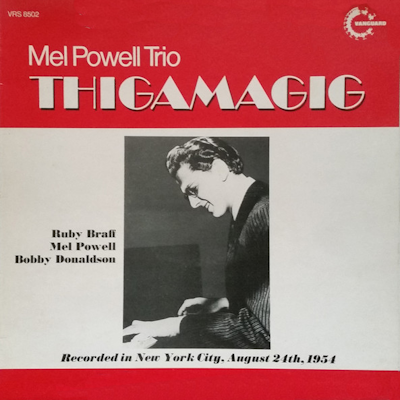
The topic of Mel Powell came up and I thought of these liner notes, written by British jazz critic Albert McCarthy (1920-1987) for a 1974 Vanguard album entitled Thigamagig (after one of Powell's compositions). 

In several respects Mel Powell was a jazz equivalent of the youthful prodigies who from time to time astonish the classical world, making his debut as leader of a Dixieland sextet in 1935 when twelve years of age. He was only sixteen when he worked with various name leaders at the famous New York club Nick’s, then after a spell with Muggsy Spanier he joined Benny Goodman’s band in June 1941. At this time Goodman led one of his finest bands and, in Eddie Sauter, possessed one of the most creative big band arrangers of the swing era, but Powell soon made his mark and before he left for army duties with Glenn Miller’s AAF orchestra had attracted considerable attention with such scores as Jersey Bounce, A String Of Pearls and Mission To Moscow.

During 1945 Powell recorded in Paris both as a soloist and as a member of a small group drawn from the Miller AAF orchestra, Django Reinhardt being a guest on some of the latter performances. After his army discharge he worked for a while in Hollywood, then concentrated on studying composition at Yale. During 1953 and 1954 he recorded a number of LPs for the Vanguard label and worked in a New York radio studio and occasionally with Benny Goodman, but by now he was concentrating more and more on composing, studying for a period with Paul Hindemith. Apart from one engagement with Benny Goodman early in 1957 he has been inactive in jazz for over a decade and a half, and has been teaching composition at the Yale School Of Music and other colleges. In 1959 he was awarded a Guggenheim Fellowship in composition and in recent years has written numerous concert material which has been performed by symphony orchestras throughout the U.S.A.

The present LP is one of two trio dates that Powell recorded for Vanguard in 1954, the other substituting tenor saxophonist Paul Quinichette for Ruby Braff. It was made at a time when Ruby Braff was making considerable impact on the jazz scene, both through the imaginative lyricism of his playing and the fact that he was stylistically a throwback to an earlier era, and arguably contains some of his finest recorded work. Drummer Bobby Donaldson, a Boston born musician, was thirty-one years of age at the time, his career having embraced various jobs with local bands, a period with service bands, and working with innumerable groups in the New York area. Donaldson, a highly competent and sensitive drummer, died at the age of forty-eight in July 1971.

Stylistically Mel Powell was something of a musical chameleon, on occasions giving what amounted to skilful impersonations of Art Tatum, Fats Waller and Teddy Wilson, but by the time the present record was made he had assimilated his various influences and a strongly romantic vein in his musical outlook was often predominant. The two numbers he wrote for the present recording - the haunting minor key title number and the wistful Bouguet ~ are both melodically and harmonically outstanding. Thigamagig has excellent solos from Powell and Braff, both of whom also take part in a chase sequence with Donaldson, and the lyrical nature of this performance sets the mood for much of the music produced on the date.

You're My Thrill is a number associated with the late Billie Holiday and this performance commences with an imaginative introduction from Powell who follows with a well conceived and thoughtful solo which highlights the strength of his left hand. Braff’s playing here is superb, his melodic variations being particularly striking, and he imparts to his solo an emotional climate that suggests he was well familiar with Billie Holiday’s recording. Button Up Your Overcoat is more extrovert - Braff’s introduction reflecting his admiration for the late Louis Armstrong, while Powell shows traces of the earlier influences of both Fats Waller and Earl Hines in the course of his solos. Don-Que-Dee, a mambo written by Bobby Donaldson, is a quite attractive theme, the drummer coming to the fore on this performance, with Powell and Braff taking a mainly subsidiary role.

Powell has written a number of attractive compositions over the years, though surprisingly enough other musicians seldom seem to play them, and Bouquet is one of the most appealing: It is an intelligently constructed piece and both Braff and Powell contribute thoughtful and well varied solos, in contrast to those on Ain’t She Sweet which, though excellent, are more straightforward. Take Me In Your Arms has particularly delicate and sensitive solo playing by Braff, while at one point in his initial solo Powell strongly reflects the influence of Teddy Wilson. The closing California, Here I Come is the only real up tempo performance of the date, Braff producing a number of his familiar runs and playing with great fluency, while Donaldson comes more to the fore than on any number other than his own Don-Que-Dee.

The U.S. jazz aficionado John Hammond was responsible for organising the session that produced the present album, as indeed he was for all the 1950s Vanguard LPs that played such a major part in creating a renewed interest in the music of the swing era jazzmen. Overall the musical worth of the records which he supervised is consistently good, though inevitably a few dates probably did not come out quite as well as he would have wished. The present LP must be considered as amongst the six finest of the whole Vanguard ‘mainstream’ series, and certainly Braff has seldom been heard in more consistently inventive form. Braff is today still very active as a musician and at the time of writing is once again recording fairly regularly, one recent album being in the form of a recreation of one of his Vanguard releases. As for Mel Powell, it seems unlikely that he will return to jazz at this late date, and on the evidence of his last recorded work — of which this album forms a part — it is a fact to be regretted.

ALBERT McCARTHY

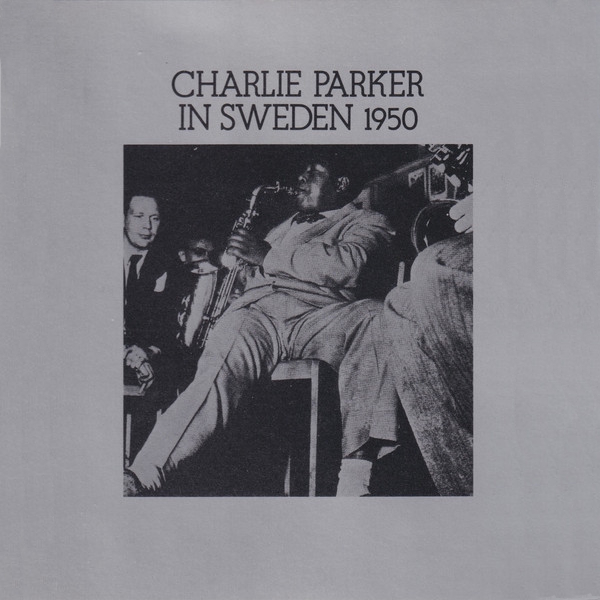
Charlie Parker in Sweden 1950

CharlieParkerInSweden 1

You may be interested to read the liner notes by Lars Werner (1934-1992) from an album recorded in 1950, released on vinyl in 1959 and re-released on CD in 1986. Mr. Werner's original notes were updated by jazz journalist Chris Albertson (1931-2019) in 1979.

Before jets and a proliferation of festivals made European appearances by American jazz musicians quite commonplace, it was not unusual for a trans-Atlantic tour to be preceded by six months of publicity. But such was not the case in November 1950, when Charlie Parker's arrival in Sweden literally took some fans by surprise. The trip was made on such short notice that booking negotiations virtually continued until his day of departure from the States. Rumors of impending visits from Parker had circulated from time to time, but so exciting was the prospect that one dared not believe them. Given the scarcity of live jazz in Europe at that time, and the fact that Charlie Parker, the Messiah of modern jazz, was already achieving legendary status, it was preordained that this visit would be a particularly memorable one. Accordingly, the November 20 Stockholm concerts and the all-night jam session (sponsored by the Stockholm Jazz Club) that followed are among my most profound and memorable emotional experiences; I am sure that Charlie Parker deeply touched everyone who heard him play on this tour, but, oddly enough, he had very little influence on his Swedish colleagues. Sure, those who accompanied Parker seemed to play with more fire and swing than usual, but that was the extent of the influence, and if it went deeper at the time, it did not surface until later.

We know now that 1950 was a good vintage for Parker's music, and he probably knew it, but in Sweden 'cool' jazz was the thing, and local musicians were far more interested in Woody Herman's Early Autumn, Stan Getz's Yesterdays, Miles Davis’ Godchild, and Lennie Tristano's Wow. By the time Parker died — prematurely, some five years later — his music and importance to jazz had become fully appreciated, even in Sweden.

The material in this album was recorded privately and under primitive conditions by a fan attending Parker's November 24, 1950 concert at the Halsingborg Folkpark and an ensuing jam session. By today’s standards, the technical quality leaves much to be desired, but such was the magnitude of Parker’s art and brevity of his career that we have learned to cherish every inch of tape containing his work. If you are a Parker collector, you will know that, substandard though it is, the sound on this album is infinitely superior to many of the private Parker recordings that have surfaced in the last two decades, but even more important is the fact that he is in splendid form. I have often wondered why it is that every new Parker solo seems to be quite different from the preceding ones even when he uses the same melodic lines; part of the answer may lie in the fact that he had such strong emotional reactions, such a great command of musical phraseology that the same line could take on an entirely different meaning from one moment to the next. But the why and how will concern only a few; what is really important is the assertive, free music in this album — long, beautiful, easy lines that lead to some of those humorous, marvelously integrated interpolations that were typical of his best work. I hope it proves to be as exciting to you now as it was to the approximately one thousand people who crowded into the dance hall of Folkets Park in Halsingborg and the seventy-five who were lucky enough to attend the session that followed, thirty years ago.

True to form, Parker opens the concert with his own Anthropology. playing magnificently in a relaxed up tempo; listen to the way he roars into Buttons and Bows, the Dinah Shore hit of that period, obviously inspiring Rolf Ericson, whose forceful trumpet style was patterned after Red Rodney's. Ericson's solo was originally followed by one from pianist Gosta Theselius, but here — as on the rest of the album — we have found it necessary to delete the piano solo due to inordinately improper balance. Scrapple From the Apple serves well to illustrate Parker's command of sequence playing; notice the way he starts his solo, the beginning of his third chorus, and the first four bars of the last eight. Parker had a wonderful affinity for ballads, and Embraceable You, which he takes in a slow to medium tempo, brings to mind Quasimodo, which he based on that tune: notice his beautiful second chorus and that by now famous Country Gardens coda. Parker's first chorus and his transition to the second are highlights of the faster-paced Cool Blues, which also contains a swinging ensemble. Star Eyes, which ends side one, and All the Things You Are, which begins side two, were originally played in tandem without interruption; both are, of course, well-known Parker vehicles by now, and he plays them here with characteristically interesting asides. Ericson solos to good advantage on the latter tune and on Strike Up the Band, which ended the concert, but does not end this album. Following the concert, some seventy-five jazz fans and musicians retired to the restaurant for refreshments and, of course, more music. There, in a relaxed atmosphere amid food and drink, some beautiful Parker solos emerged and, fortunately, were recorded. Body and Soul — which became a classic at the hands of Coleman Hawkins — is played in the popular double tempo of the day, we enter it just before the bridge, in time to catch two and a half choruses of graceful, singing lines by Parker. Here, again, some heavy editing was called for and, following Parker's solo, it was necessary to remove lengthy statements by Norwegian trumpeter Rowland Greenberg and Gésta Theselius (playing tenor this time); both men are, however, heard during the out chorus wherein Parker injects a lovely fragment of Debussy's Claire de Lune, and Greenberg rounds things out with the obligatory strain from Prisoner of Love. With Theselius  on tenor, the pianist for this informal session was Lennart Nilsson, but he too was a victim of poor balance whose work had to be edited out; if there was a bassist present {some discographies list Thore Jederby as a possible participant), the non-professional tape recorder refused to acknowledge it.

Parker kicks off Fine and Dandy with five driving choruses, the first two of which receive some good brush-work backing that has been attributed to drummer Jack Noren, but some corny 'bombs' elsewhere on these recordings belie the notion. Here, again, editing was called for and I had to discard a decent but overly long solo by Rolf Ericson, and one by Lennart Nilsson (you will notice the jump to Parker’s second entrance, which consists of a quote from When the Red Red Robin..., etc. and leads to his trading fours with Ericson before easing into Miles’ Little Willie Leaps for the last sixteen bars). The final number, How High the Moon, starts charmingly with an a capella statement from Parker, who presumably is also responsible for the foot-tapping that sets off the rhythm section. Here, too, editing was done, but mainly to make room for the out chorus and its Ornithology theme.

Lars Werner,
Swedish jazz critic, Orkesterjournaien.

Original 1959 notes edited and updated by Chris Albertson — 1979.

Peter Leitch

Peter Leitch

I've been listening to a lot of Peter Leitch (1944-2024) lately.  The supremely talented guitarist, composer, arranger, bandleader released a number of recordings over the past 40-some years that form an impressive legacy.  I have lots, but I've been concentrating on Exhilaration (recorded mostly in 1984 and re-released on CD in 1988), Red Zone (recorded and released in 1987), From Another Perspective (from 1993) and Autobiography (from 2004).  Unlike many lucky folks, I didn't know him well at all, only speaking to him once in Toronto between sets with his trio at George's Spaghetti House (before any of these albums were produced).  It was early in the week and the place was practically deserted, but he played everything for keeps - varied repertoire, great sound, precise rhythm and constant intensity.  These albums show how those characteristics developed over the years to build a great master of the art form. 

Ralph Towner

Ralph Towner


If you were a record collector in the 1960s, you may have encountered Ralph Towner as a sideman with the freshly eclectic Paul Winter Consort.  Remarkable among jazz guitarists of the era, he only played nylon-string acoustic.  His sound was perfect for the Winter ensemble, which was collectively busy inventing the 'New Age' genre.  The enormously talented Mr. Towner died in Rome on January 26, 2026 at the age of 85. 

World Music collectors will certainly be interested in his body of work with Oregon, a group he founded in 1970 with Paul McCandless, Glen Moore and Collin Walcott. After a few Vanguard releases, the band moved to the ECM label in the 1980s and most of Mr. Towner's recordings as leader since that time have appeared on that label.  Beside 6- and 12-string guitars, he played keyboards (especially piano), trumpet, French horn and percussion.  His music had great depth and integrity, being at once skillful and original.

Benny Golson

Benny Golson

I can remember hearing Along Came Betty for the first time - its subtle groove and bebop hipness was infectious. I transcribed it and tried to convince everyone I worked with to play it, even on black-ties (with limited success). Benny Golson wrote it and he died at 95 a little over a month ago. He leaves Sonny Rollins with the distinction of being the last survivor of A Great Day in Harlem. Benny was a superb tenor player and that would have been enough to merit our attention to his passing. But his compositions take him to "Legend" status, compositions like Betty, I Remember Clifford, Stablemates and Killer Joe. He ascended in a relentless arc from DB New Star in 1957 to NEA Jazz Master in 1996, on to a Guggenheim Fellowship in 2004 and (finally) to the DownBeat Hall of Fame in 2018.  I remember Benny.

Congrats to MBBJE!

Congrats to MBBJE!

At their July Port Credit Legion gig, the Mississauga Big Band Jazz Ensemble (MBBJE) celebrated two significant milestones with some serious cake!  The MBBJE's long-time drummer, Jay Boehmer, is retiring from the band after 22 years of dedicated service; and leader Rob Boniface was recognized with a Lifetime Achievement Award from the Mississauga Arts Council for founding and leading the MBBJE over the past 47 years.  Congratulations and thank you, gentlemen - on behalf of Live Jazz fans in Mississauga and Beyond!

Congratulations, Charles Lloyd!

Congratulations, Charles Lloyd!

Congratulations go out to Charles Lloyd, on his remarkable 4-category win in the 2024 DownBeat Critics' Poll: Hall of Fame, Tenor Saxophone, Small Group and Album of the Year!  Seeking consensus among jazz critics on any one category is normally an exercise in cat-herding, but this level of agreement is unfamiliar territory.  But Mr. Lloyd has a long history of bucking the trends and quietly slipping through the troubled waters of style and fashion to settle into his own niche, far above the squabbles of the day.  His introspective, quirky, personal approach to jazz has survived pretty much intact for six decades and sounds as fresh as it did in the 1960s when his greatest triumphs came at fledgling (now venerable) jazz festivals. His Quartet at that time featured Keith Jarrett, Cecil McBee and Jack DeJohnette; lately his core groups include the likes of Gerald Clayton, Jason Moran, Larry Grenadier, Reuben Rogers, Eric Harland, Brian Blade... Charles Lloyd is a giant among giants.

David Sanborn

David Sanborn

David Sanborn died on May 12th, 2024 at 78 years of age.  One of the truly dominant voices in contemporary music, David Sanborn was, in contrast to his often blistering solos, a quiet, respectful, shyly reticent man. He made a string of albums that reached #1 on the Jazz charts, won six Grammy awards, and co-hosted a ground-breaking music television show.

We will miss his skill, his creative energy and dedication to his roots in so many subtly different genres.

Richard Davis

Richard Davis

Richard Davis, respected bassist and NEA Jazz Master, died on September 6th, 2023 at 93 years of age.  Anyone who has heard Van Morrison's Brown-Eyed Girl has heard Richard Davis.  Anyone who has heard Pat Martino's Baiyina, The Visit!, or Exit knows who Richard Davis was.  

A favourite in the DownDeat Readers' Poll in the late 60s & early 70s, he had grown up in Chicago, earning a music education degree in 1952.  His first major employers, Ahmad Jamal, Don Shirley, and Sarah Vaughan prepared him for a career in the forefront of of jazz, while keeping him open to the possibilities of other forms. 

Which brings me to Astral Weeks... This Van Morrison album opened the pop door for jazzers - and it was down to Richard Davis to execute, which he did! His first three notes on Brown-Eyed Girl set the confident, exuberant tone... and it never lets up.  With Jay Berliner and Connie Kay, Richard Davis brought the potential of jazz to a whole new (and pretty much clueless) audience.  I'm not sure they ever understood what was going on, but they were influenced to some extent.

Then we get to Pat Martino's Exit - recorded in 1976 - featuring Gil Goldstein, Billy Hart and, of course, Richard Davis who clearly runs the accompaniment strategy underpinning Martino's virtuosic excursions. Days of Wine and Roses is meticulous above and beyond even New York studio standards; Blue Bossa has a translucent energy and muscle that it rarely felt before; I Remember Clifford draws tears without the faintest trace of vibrato; and Exit shows 70s jazz reaching the level of high art, thanks to the restless interplay between bass and guitar - Richard Davis and Pat Martino.

These days are gone and these men are gone - Davis and Martino - but I have an original vinyl pressing of Exit in my hand and it's a living piece of jazz legacy!  And I believe that jazzers everywhere owe them a clink of their glasses for showing the way to another level.